
Consulting · workshops · joint projects

From the symposium to your shop floor: we offer what we discuss at our symposia as consulting – vendor-neutral, close to application and backed by our own labs and research projects.
Behind re.academy stand Trier University of Applied Sciences at Umwelt-Campus Birkenfeld and especially the Birkenfeld Institutes of Technology (BIT) – an interdisciplinary research group that works on robotics, manufacturing and assembly with fewer resources, less CO2 and more circular economy.
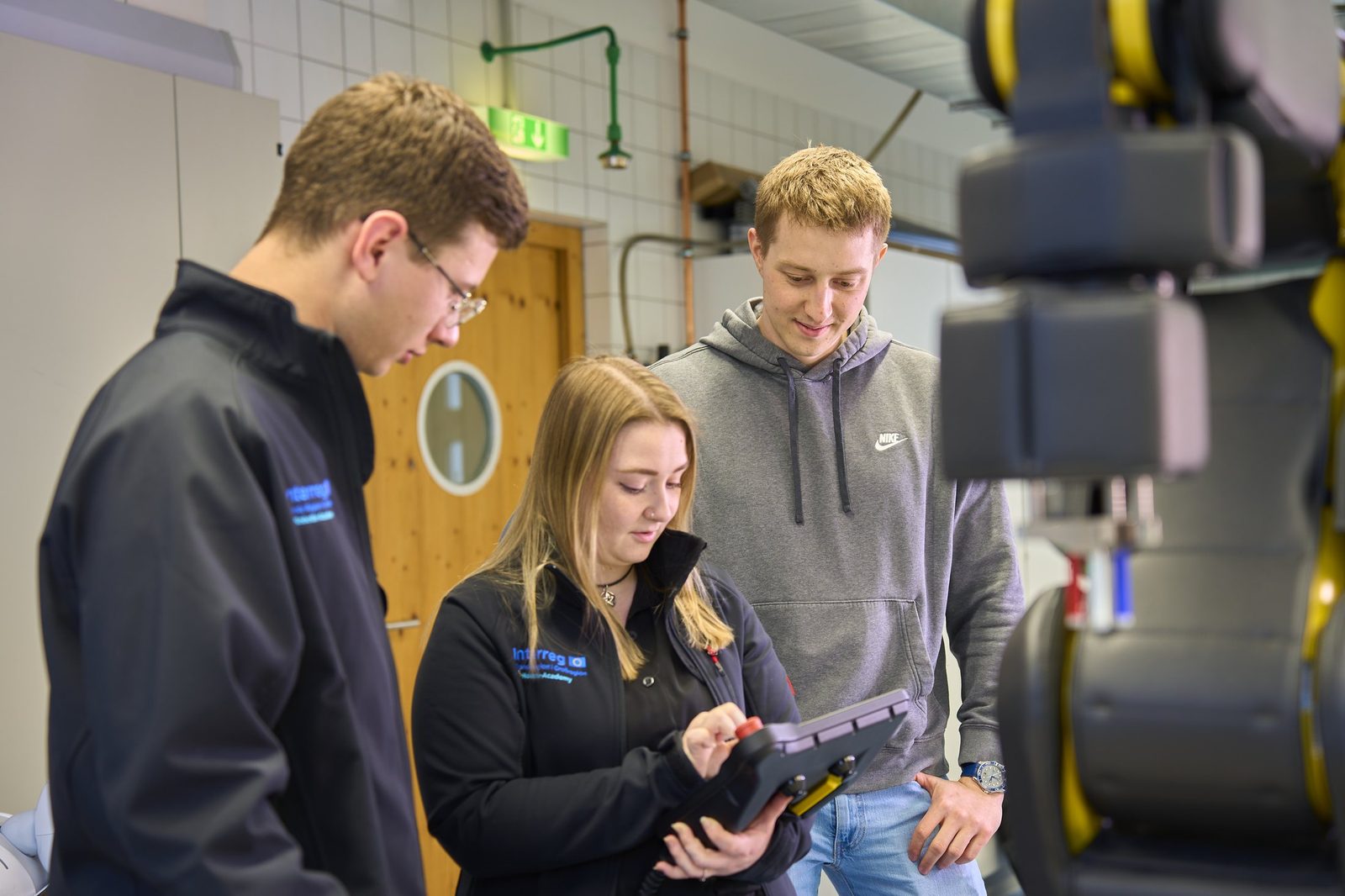
Offers
How we can support you
Initial orientation
A first conversation about your product or process: is remanufacturing an option, what can be automated, where do you start? Vendor-neutral, without product sales.
Workshops
Eco-design, life cycle assessment and strategy workshops of one to three days, tailored to your products and team. More below.
Workshop formats →Studies and prototypes
A direct commission for a feasibility study, a test setup or a demonstrator – for example for automated disassembly, inspection or cleaning.
Joint research projects
Users, suppliers and research develop a solution together. We check funding options with you.
Training and qualification
Training in robotics, automation, safety, machine vision, AI and remanufacturing – from a lab day to a series.
Students and theses
Cooperative bachelor and master theses and doctorates – and direct access to young talent.
Workshops
Formats for your team
All formats are modular: from a focused one-day session to an in-depth two- or three-day workshop. Scope and depth depend on your goals and team. A workshop creates clarity, direction and capability; implementation takes place in your organisation – if you wish, we continue to support you.
Eco-design workshop
Build future-proof products: integrate eco-design systematically into product development and apply it directly to your own products – materials, design and life cycle.
LCA workshop
Make decisions with data: measure and interpret environmental impacts and apply life cycle assessment in practice with OpenLCA.
Strategy workshop
Turn sustainability into action: target vision, prioritised fields of action and a roadmap that aligns regulation, market and internal capabilities.
Re-X workshop series
The seven modules of the 2026 online series as an in-house format: eco-design, robotics & AI, inspection and cleaning, business models, disassembly and reverse logistics, product passport, regulation.
The seven modules →Interested in a workshop? Tell us briefly which format and which product or process – Write to us: robotik@umwelt-campus.de
Expertise
Birkenfeld Institutes of Technology (BIT)
BIT is an interdisciplinary research group at Umwelt-Campus Birkenfeld, led by Prof. Dr.-Ing. Matthias Vette-Steinkamp and Prof. Dr.-Ing. Florian Mohr. It brings together computer science, mechanical engineering, process engineering and industrial engineering – application-oriented and in close cooperation with industry.
- €10 m+third-party funding
- 20+ongoing projects
- 35+staff
- 55projects on the BIT project list
Applied circular economy
Remanufacturing, disassembly of batteries and e-drives, digital product passport, eco-design.
Industrial robotics
Human-robot collaboration, gripping, safety and risk assessment, humanoid robotics.
Artificial intelligence
Machine vision, AI assistance systems and local AI with full data sovereignty.
Cyber-physical systems
Edge-cloud architectures, IoT and the digital retrofit of machines.
Distributed communication architectures
Secure, connected production systems and data spaces.
How we work: vendor-neutral and solution-neutral research, problem solving at the customer instead of product sales, and transfer secured by consortia of users, suppliers and research.
Topics
What we work on
- Digitisation, digital twin and product passport
- Remanufacturing as a new business model for manufacturers
- Robotics and automation – from cobots to humanoid robots
- Inspection, testing and cleaning
- Disassembly of batteries, e-drives and electronics
- Additive manufacturing
- Logistics and supply chain management, core management
- Eco-design and legal requirements
- Reverse engineering, tolerances and metrology
- Artificial intelligence in products and production
- Assistance systems for manual processes
Labs
Where it happens
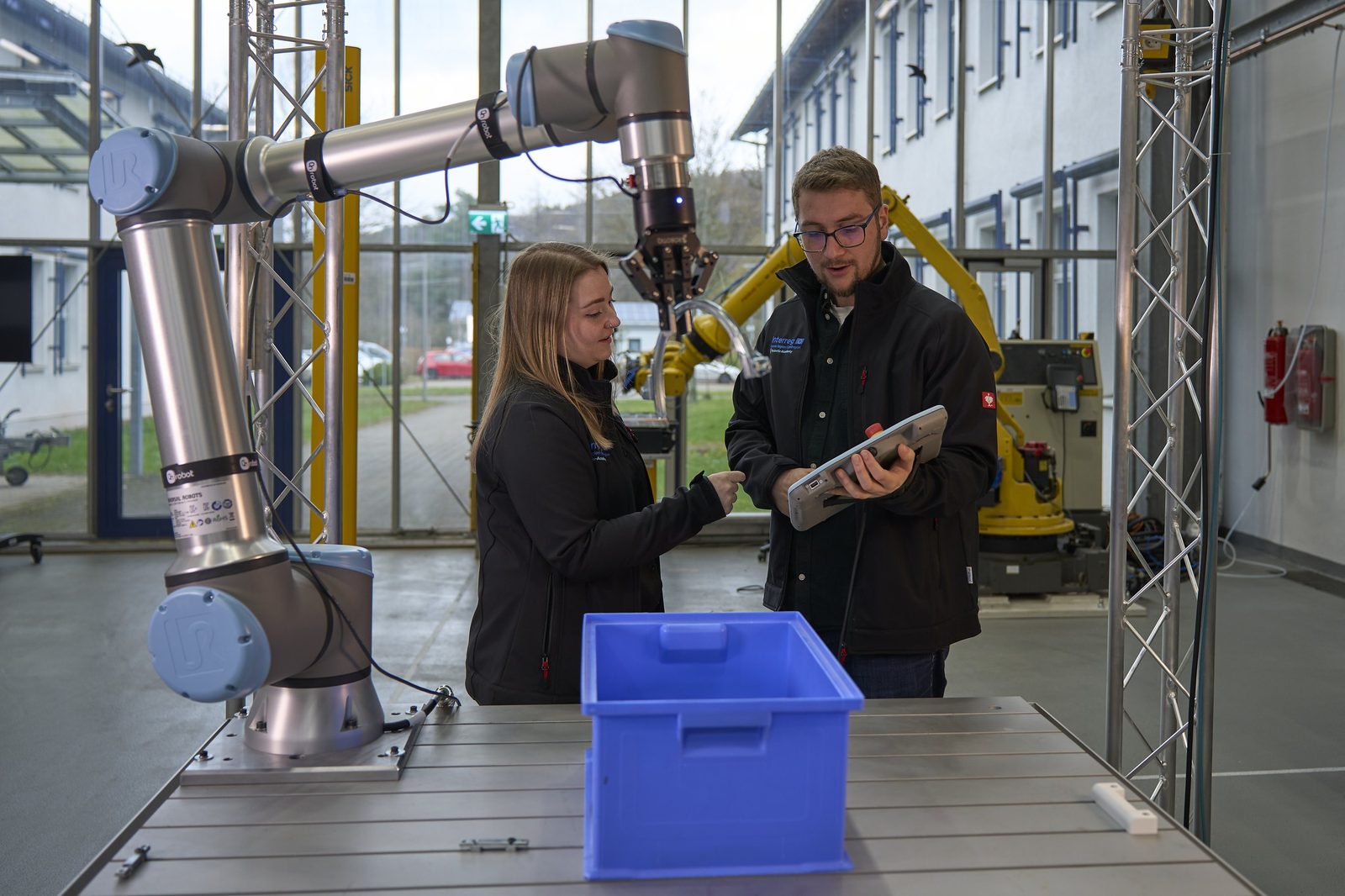
Robotics lab
Development of new control and robot applications, basic training in automation, robotics and drive technology, and test benches for research projects.
Battery disassembly
Robots disassemble high-voltage battery systems for reuse or recycling; they take over hazardous and ergonomically difficult tasks while intelligent tools assist people.
AI lab
Students and regional companies develop AI applications together and test them in real environments.
3D printing
About forty printers with build volumes of up to one cubic metre, for flexible to acid-resistant plastics, plus printers for aluminium, tool steel and stainless steel.
Battery and fuel cell lab
Manufacturing and characterisation of components for lithium-ion batteries, fuel cells and redox flow cells, plus an electronics workshop.
References
Selected projects
A selection from the BIT project list. Many projects were funded by the EU (Interreg, ERDF), the federal government and the state of Rhineland-Palatinate.
Remanufacturing, disassembly and circular economy
- Ongoing RemanPass Partially automated disassembly of high-voltage batteries for remanufacturing, guided by digital product passports and AR/VR assistance. Project page
- Ongoing DIFFERENCE Laser-based and automated disassembly for the circular use and recycling of highly integrated cell-to-pack battery systems.
- Ongoing Kraft2R A cognitive robot system for the automated disassembly of battery-containing products and the recovery of valuable raw materials.
- Ongoing Re-Use Services for flexible, sustainable and demand-driven automation of battery disassembly processes.
- Completed ZirkulEA A circular value chain for the electric drivetrain through intelligent disassembly and cross-company information exchange. Project page
- Completed Reman4E-Scooter Prototype for the automated, robot-based disassembly of e-scooters as the first step of remanufacturing (TRL 6). Project page
- Ongoing PAE-e-green Decarbonising the e-mobility value chain in the Greater Region, with demonstrators from production to end of life. Interreg Greater Region. Project page
- Ongoing GreenFab Helps small and medium-sized companies design resource-efficient production and logistics processes for the circular economy.
- Completed KI-Genf An energy-efficient recycling line for plastics combined with 3D printing. Project page
Robotics, automation and inspection
- Ongoing OptiGrip A modular, adaptive multi-point gripping system for flexible and safe human-robot collaboration.
- Ongoing MRK Konfig AI-based assistance that captures customer requirements and configures individual automation solutions in plant engineering.
- Ongoing MobileFabs Mobile, modular micro-factories for flexible, location-independent production on demand.
- Ongoing Retro-Q Digital retrofitting of long-lived machine tools. Project page
- Ongoing LabFlex An adaptive, AI-supported automation concept for laboratory processes in the life sciences. Project page
- Completed MRK Safe An assistance system for process-oriented risk assessment of human-robot collaboration. Project page
- Completed MRK Strahlen Flexible automation for polishing cutting tools with a six-axis industrial robot. Project page
- Completed Instent An automated, robot-guided optical inspection method for medical stents. Project page
- Completed KI-MAP-Qualdromat Automated characterisation of plastic samples with robotics and artificial intelligence. Project page
Transfer, qualification and digital production
- Ongoing Robot-Hub Transfer Cross-border robotics hub: initial consulting and potential assessments for SMEs in Germany, France and Switzerland, up to their own robot system. Interreg Upper Rhine. Project page
- Ongoing Robot-Hub Academie Training and qualification in robotics to counter the shortage of skilled workers in the region. Project page
- Completed Robotix Academy Cross-border research cluster for industrial robotics and human-robot collaboration in the Greater Region, with lectures, summer schools and the RACIR conference. Project page
- Completed COTEMACO Enabled manufacturing SMEs to integrate collaborative robots and digital technologies. Project page
- Ongoing FENI-X Methods and digital tools to assess and strengthen the resilience of production companies and networks.
- Completed EASY An easy-to-use edge-cloud continuum for productivity and resource efficiency across manufacturing. Project page
Contact
Let's talk
Briefly describe your product, process or question. We will tell you which format fits and who on our team is the right contact.
Prof. Dr.-Ing. Matthias Vette-Steinkamp
robotik@umwelt-campus.de